MODULE II FOR PARENTS Foundations of Augmentative and Alternative Communication (AAC)
MODULE II FOR PARENTS Foundations of Augmentative and Alternative Communication (AAC)
Résumé de section
-
MODULE II
FOR PARENTSFoundations of Augmentative and Alternative Communication (AAC)
Augmentative and Alternative Communication technique for Inclusion (AAC-Inclusion)

1. Communication tools - symbols, books, boards.
Low-tech communication aids.
These are aids that do not require the use of technology. They are commonly called paper-based aids. They contain appropriately selected and arranged vocabulary. They can be created both with popular graphic programs and with dedicated AAC programs containing symbol sets. Such programs make it possible to choose symbols, arrange them on a page, adjust their size, edit them and print them. The best-known examples in Poland include:
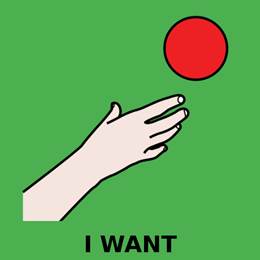
1. Picture Communication Symbols (PCS) - a set containing several thousand American symbols. The Boardmaker program allows users to edit the symbols and print boards.
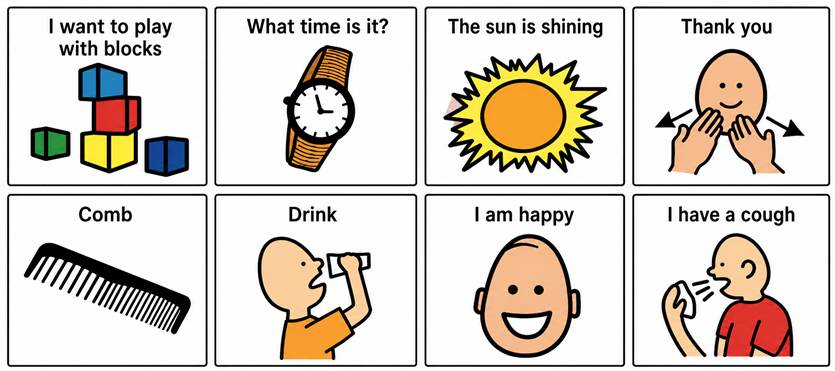
Source: Boardmaker program. Makaton Communication Development Programme.
2. MÓWik Symbols - around 12,000 Polish symbols. They can be edited and printed using MÓWik Print. They are also used in ready-made teaching aids.
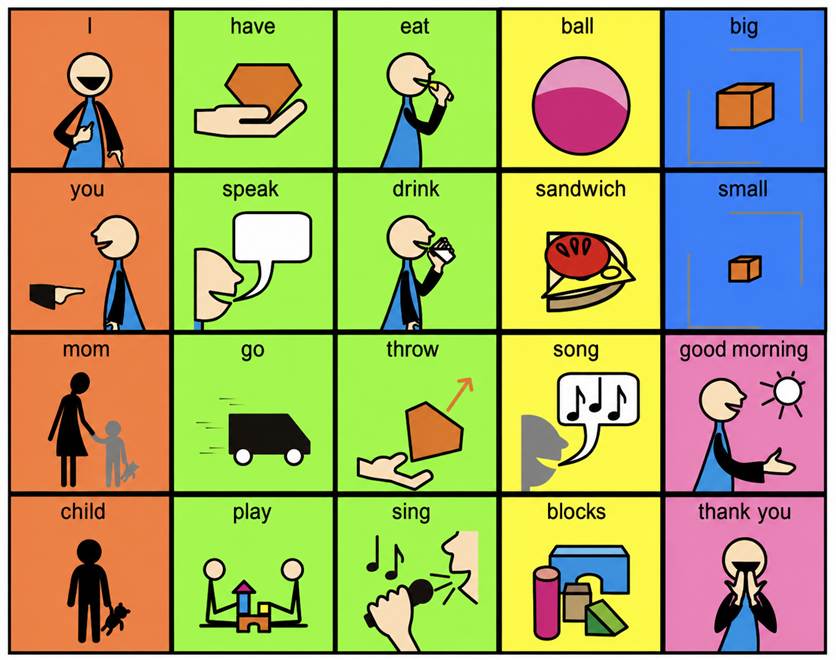
Source: own resources, board created in MÓWik Print.
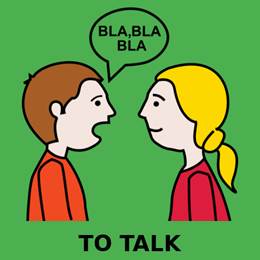
3. Makaton Symbols - Makaton includes both symbols (approx. 10,000) and signs/gestures. They can be used to create boards in SymTab.
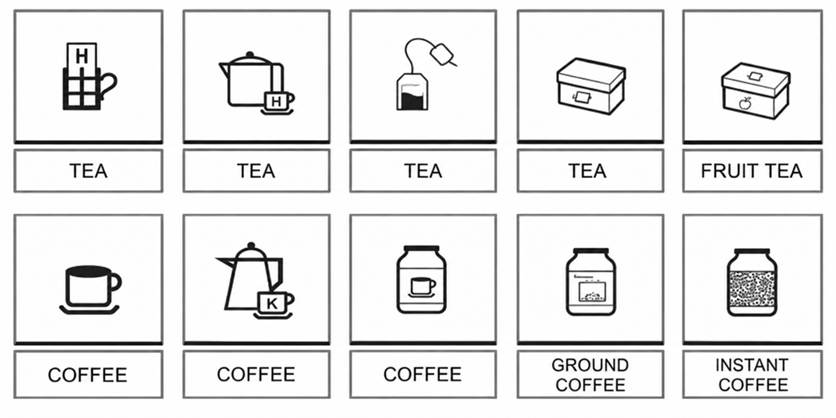
Source: graphic symbol database of the Makaton system. Level: "Food". Makaton Communication Development Programme.
4. PIC Pictograms - Picture Ideogram Communication: white symbols on a black background. The set contains about two thousand ideograms and pictures. They are available in the Pictogram Language program and in teaching aids.
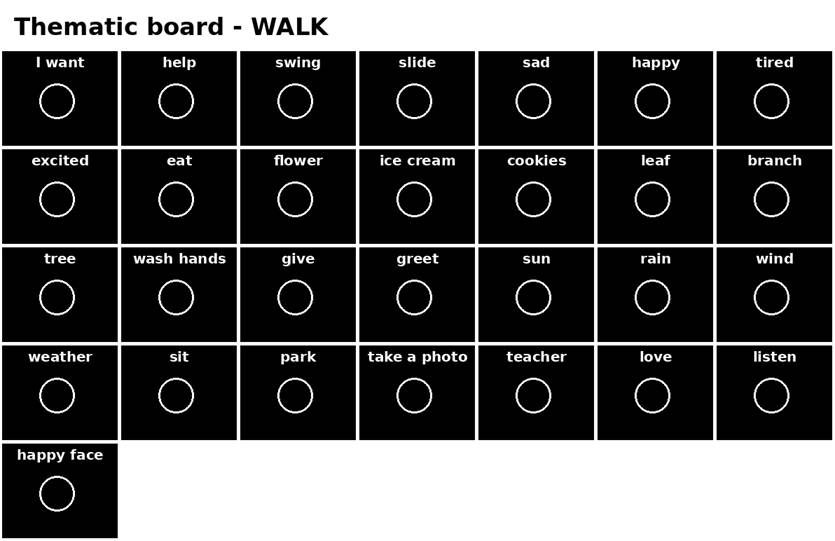
Source: collection of the Non-Public Consultation and Training Speech Therapy Centre "Pictograms" in Szczecin.
5. Arasaac Symbols - a free set of around 12,000 symbols available online: https://arasaac.org/aac/pl.

Creating communication books.
A communication book is a personal, multi-page aid for an AAC user. It contains vocabulary important to the user, presented as AAC symbols, and enables communication with other people. Symbols are placed on several surfaces that the user can control directly or indirectly and to which the user has access. The messages are configured in grids, most often in rows and columns, arranged on the surface according to a specific organizational strategy - thematic (the linguistic organization of the vocabulary system) or linguistic. The number of symbols on a page depends on the user’s age, cognitive skills and physical abilities. The scope of vocabulary changes with the development (age, abilities), needs and interests of the owner of the book. The book may take the form of a large or small binder, joined sheets of paper or connected communication boards, with symbols fixed permanently or removable (with Velcro or magnets). It can be made of different materials (plastic, cardboard or textured materials). Its design, size, quality (e.g. with objects, photographs, pictures or letters), number of pages and scope should correspond to the individual abilities and needs of the user (e.g. categorized or thematic communication books) identified during AAC assessment.
Selection of vocabulary and linguistic organization of the system.
Selecting vocabulary is an important element in planning a communication strategy. The first signs used are most often connected with the user’s interests and needs. They relate to a concrete context or phenomenon known to the user and to things that are close to the user. Vocabulary changes as communication experiences are gained. The use of a particular type of signs and their combinations depends on the preferences of the user and their communication partners [Grycman, Jerzyk, Bucyk 2020].
To determine vocabulary precisely for an AAC user, Alina Smyczek developed an interview questionnaire.
Vocabulary for a person who needs AAC - interview questionnaire
The purpose of this form is to collect vocabulary for the person for whom a communication aid is being designed. Since we most often talk about what happens to us, what we take part in and what engages us emotionally, this is the vocabulary that is most needed.
In each category, please provide the words that are most needed to describe the world in which the nonspeaking person lives. Access to more neutral and universal vocabulary is also needed, but this can be indicated by the therapist. Words connected with the life of the nonspeaking person can only be suggested by people close to that person, who know the person well, including their style, needs, interests and communication situations. If an area of the form below does not apply to the nonspeaking person, please omit it and do not fill in those places in the table.
*If a word fits several categories, it may be entered several times.
Name and surname of the person who needs AAC: ................................
Age: ................................
Who is participating in completing the form: ................................
1. PEOPLE AND CHARACTERS
a. Family
Adults
Children / peers
b. Acquaintances
Adults
Children / peers
c. People from school/kindergarten
Adults
Children / peers
d. People from other environments, with a description of who they are, e.g. Ms Zosia, neighbour, Father Jerzy, etc.
e. Other important people
f. Important characters from films and books
2. PLACES
a. Places at home and around the home
b. Places at school/kindergarten
c. Places outside home and school
Parents’ workplaces
Places the person goes to every day or regularly
Favourite places
Disliked places
Important places where the person has been or wants to be (e.g. countries, cities, geographical regions)
3. ACTIVITIES
a. Daily activities
b. Household duties/activities
c. School activities
Names of classes
Names of additional activities
d. Favourite activities/classes
e. Hobbies/passions
f. Disliked activities/classes
g. Important activities of significant people
4. THINGS
a. Important personal items
b. Equipment and everyday aids
c. Important school-related objects
d. Important leisure-time objects
games, puzzles
books
magazines
toys
other
e. Other important objects
f. Vocabulary related to dressing
g. Vocabulary related to hygiene
h. Other important words related to things
5. HEALTH/WELL-BEING
a. Important illnesses or risks of deterioration of health
b. Procedures and activities needed to maintain the user’s good condition
c. Other words related to health
6. FOOD AND DRINK
a. Frequently eaten/favourite products
b. Frequently eaten/favourite dishes
c. Disliked products
d. Disliked dishes
e. Special recommendations (allergies, diets)
f. Other words related to food
7. COMPUTER / SMARTPHONE / TABLET
a. Names of devices and accessories used
b. Names of programs/applications used
c. Topics/names of favourite websites
d. Most common difficulties
e. Other words related to the computer
8. MUSIC
a. Liked music
type
performers
instruments
b. Disliked music
type
performers
instruments
c. Ways of listening to music
d. Other words related to listening to music
9. TELEVISION / VIDEO / DVD
a. Equipment for watching films/programmes
b. Available TV channels
c. Most important channels
d. Favourite (F) / disliked (D) programmes
e. Favourite (F) / disliked (D) series
f. Favourite (F) / disliked (D) films
g. Favourite (F) / disliked (D) artists
h. Other words related to TV/video/DVD
10. SPORT
a. Favourite (F) / disliked (D) sports
b. Favourite athletes
c. Sports practised/necessary equipment
11. NATURE
a. Favourite animals/plants
b. Disliked animals/plants
c. Words related to nature
12. TECHNOLOGY
a. Important vehicles
b. Important technical devices
c. Other words related to technology
13. RELIGION
a. Important objects related to religion
b. Important rituals/activities related to religion
c. Other words related to religion
14. CELEBRATIONS / HOLIDAYS / EVENTS
a. In the family
b. At school/kindergarten
c. In the local community
15. BEHAVIOUR REGULATION
a. Difficulties in functioning/behaviour
b. Ways of coping with behaviour/functioning (soothing activities)
16. MOST COMMON CONVERSATION TOPICS OF THE NONSPEAKING PERSON
a. With everyone
b. With mother
c. With father
d ........................................
e ........................................
f ........................................
Alina Smyczek, Kraków 2009-2014.
The linguistic organization of the system concerns the way signs are arranged and highlighted in AAC aids. It supports learning how to navigate the system. One form of system organization is communication boards (e.g. a main board, choice boards, thematic boards, a board with a section of always-available signs, an alphabetic communication board, boards for writing utterances, dynamic boards). They may have different levels of complexity. The frequency of use of a word/sign may be the key to their placement in AAC aids.
The appropriate appearance of signs is useful in locating desired messages on a communication board. Colour, borders, bolding and background may support the user.
The challenge is to organize the language system in such a way that it enables the user to create messages freely and quickly. The layout of signs should be understandable and encourage communication partners to engage in conversation, as well as support learning grammatical forms and building correct sentences. The use of colours helps some users to understand language structures better and to combine graphic signs into phrases and sentences. A conventional colour-based system for building utterances can help organize vocabulary. It is important to use one consistent key in all AAC aids created for the user’s individual needs [Grycman, Jerzyk, Bucyk 2020].
The Fitzgerald Key is a commonly used colour code. In Poland the following colour code applies:
People
orange
Actions
green
Descriptions
blue
Nouns
yellow
Conversational phrases
pink
Other
white
Navigation within an individual communication system.
An individual communication system consists of many different components. Both the AAC user and the communication partner need to learn it. A very important principle is to use motor memory in the learning process. Signs/symbols should not change their initial position in the communication aid.
Communication boards
Example boards from communication books.
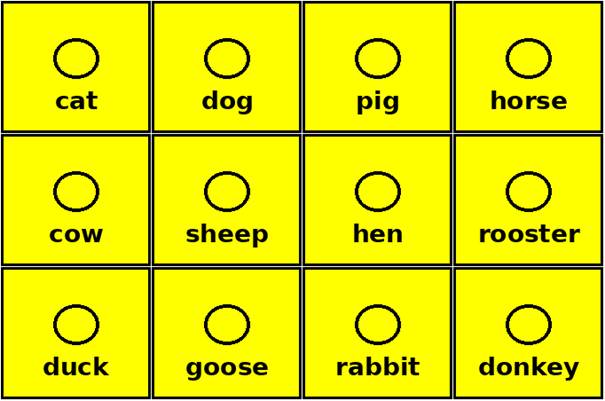
Source: own resources, MÓWik Print symbols.
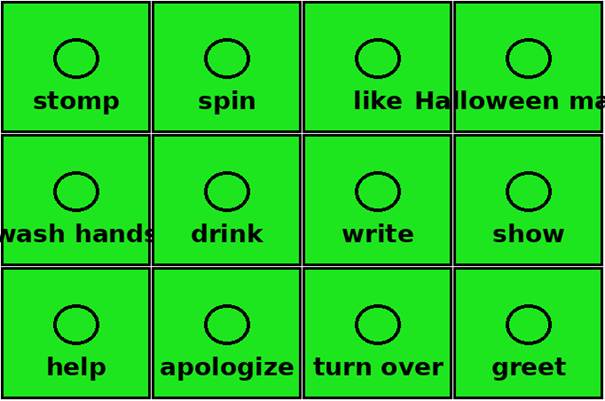
Source: own resources, MÓWik Print symbols.
Source: collection of the Krystyna Rajtar Rehabilitation, Education and Care Centre in Jarosław operating under the Polish Association for Persons with Intellectual Disabilities, Jarosław Branch.
Daily schedules are graphic representations of the stages of a day, such as lessons, classes or activities. The benefits of using daily schedules include building the concept of time, enabling communication about the past and the future, increasing the sense of safety, providing predictability for the student and thereby reducing challenging behaviours, preventing rigid patterns and frustration, teaching delayed gratification, and supporting comprehension and receptive language. Daily schedules will be particularly useful for students who:
• constantly ask the same questions about activities and people important to them (a particular toy, a parent’s return, etc.);
• have considerable difficulty understanding the concepts of “now” and “later”;
• show problems with concentration;
• have difficulty with changes;
• have problems transitioning between activities.
The “now, then” schedule.
A simple “now, then” board can also be used to indicate the consequence of a task. An activity that is challenging for the student should be paired with an attractive consequence, for example: now reading, then listening to music. This schedule contains only two symbols: one for the current activity and the other for the activity that follows. Such a board may be used as an introduction to schedules, and it may also be beneficial for students who have particular difficulty changing activities or focusing on them.
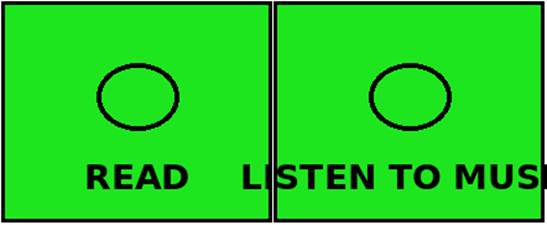
Source: symbols: MÓWik.
Visualization of instructions
One of the greatest challenges in therapeutic work is giving instructions effectively. Verbal instructions require the student to have good language comprehension, memory and auditory processing. To help the child carry out an instruction and understand what is expected, the spoken messages addressed to the child can be illustrated with symbols. This may be particularly useful, for example, in feeding therapy or during breathing exercises.
Benefits of visual support for instructions for the child:
• increased attention and focus,
• increased concentration,
• increased independence.
Benefits of using visual support for instructions from the perspective of a speech therapist:
• less time spent repeating the same instructions and prompts,
• easier planning and structuring of instructions.
Creating an aid that supports giving instructions should be preceded by an analysis of which words and instructions are used most often during a given activity. Then the symbols representing them should be printed in a format visible to the child. These symbols should be easily available to the therapist - for example, in a binder with symbols placed on the desk or on a symbol lanyard.
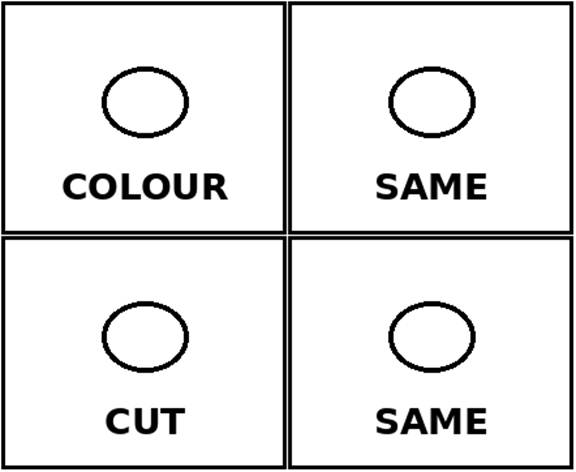
Visualization of instructions, own resources, source: MÓWik symbols.
Using reinforcers and motivators
Many children may have difficulty completing tasks and following instructions. Praise from the therapist alone may not motivate them enough to engage and complete a task or instruction. For this group of children, it is recommended to use reinforcement and a visual representation of the conditions for receiving it. In selecting objects and activities that motivate the child, observation, discussion with parents/guardians and consultation with the teacher are recommended.
After selecting reinforcers, it is necessary to decide what conditions the child must meet to gain access to the reinforcement, and how long/in what amount/how often it will be provided. The participant must have clearly presented expectations with a clearly specified outcome, for example, they must tidy up toys in order to do a favourite activity for 5 minutes.
Next, both the way of marking the stages separating the child from the reinforcement and the reward itself should be shown. The simplest form is colouring in or covering the stages leading to the reinforcement. Another option is to cut the symbol of the reinforcement like a puzzle into as many pieces as there are stages needed to obtain the reward. For each task the participant receives one piece of the picture and gradually completes the reward. After completing the whole picture, they receive it. Boards with attachable tokens or buttons and stickers may also be used.
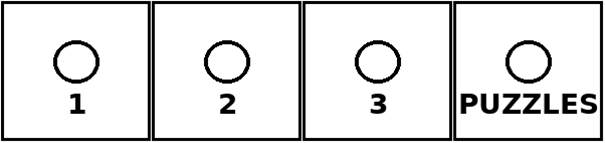
Alternative consequences map
This is a visual representation of the relationship: expectation - behaviour - consequence. The purpose of such a map is to present graphically both the expected behaviour and the reward for it, while both options are shown at the same time. The map must show:
• the common antecedent, occurring both before the undesirable behaviour and before the appropriate alternative behaviour;
• a description of the undesirable behaviour and the appropriate alternative behaviour;
• the consequences of both behaviours.
Using visual support in therapeutic work, also with speaking children, may initially raise concerns because AAC is often associated with a strategy for nonspeaking students. However, it is important to realize that each of us uses different forms of visual support in everyday life: calendars, timetables, schedules, traffic signs, etc. They help us remember and understand the expectations placed on us.
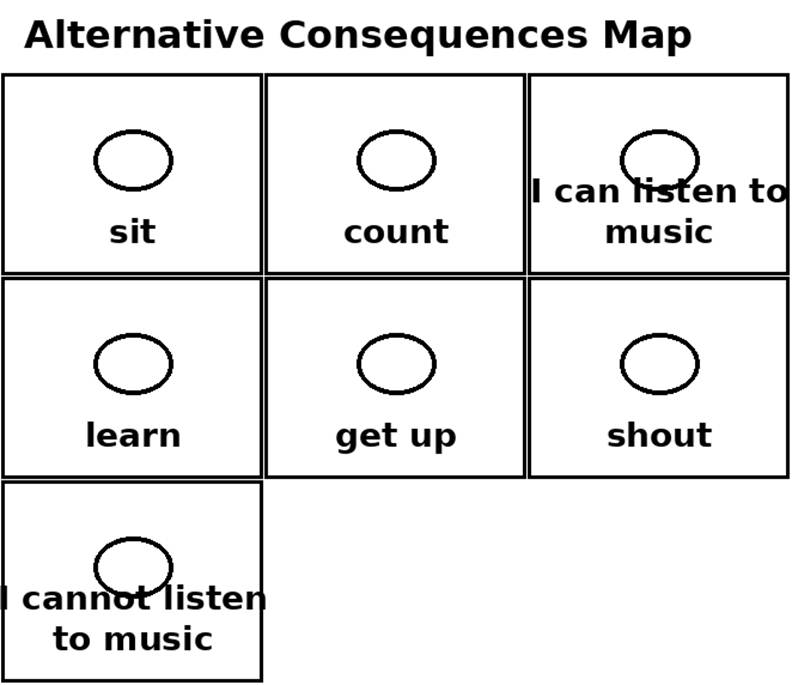
Own resources: source: MÓWik symbols.
Using a choice board during home activities.
A choice board contains symbols representing concepts from which the child can choose an object, activity, game, food, etc. Symbols are helpful at the stage of work with a child who is just beginning to learn communication. They enable the functions of requesting and asking for something. The participant makes a free choice without the possibility of being wrong - the indication is always correct and is not judged negatively or positively by the conversation partner. Sometimes fulfilling the wish is not possible for objective reasons. Then one should say, for example: “You are showing that you want YOGURT. I understand. But we do not have any today because I forgot to buy it. You can choose something else - JUICE or JELLY” - here the parent points to the relevant symbols. The choice must be strictly connected with the situational context and relate to the current situation. It is unacceptable to encourage the child to choose, for example, what they will want to do in a few hours and then enforce it (“because that is what you chose in the morning”). During a choice, misunderstandings may occur; therefore, it is always necessary to say aloud how the indication was understood, for example: “You are showing blueberries. Do you want us to sing a song about blueberries?” The child then has a chance to change the message if the symbol was selected by mistake.
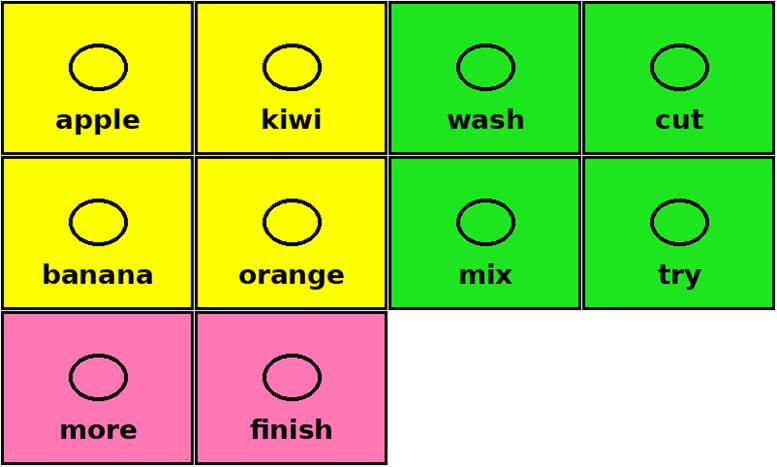
Own resources: source: MÓWik symbols.
Creating a context board using photographs
A context board contains vocabulary used in a strictly defined situational context. It is not intended for talking about a topic detached from the context. It should include different parts of speech; symbols for concepts related to the given situation, used for naming and requesting objects, actions, features and people belonging to the situation; and conversational phrases (exclamations, polite phrases, requests, questions, etc.) usually used in that context. Context boards can be constructed in two ways. For beginners in AAC, boards are created on the basis of a photograph of a given situation. For example, on a large photograph showing play with favourite soap bubbles, symbols representing particular concepts are placed. The board may be paper-based or electronic with an interactive board or a touch-screen device (e.g. PowerPoint, Grid, Mówik Book or Boardmaker SDP). The latter boards are more attractive because, after touching a specific place in the photograph, the appropriate message is heard.
A board for more advanced users no longer has a photograph in the background, but it still contains vocabulary only for that particular context. Sometimes symbol-only context boards are a continuation of boards with a photograph and contain the symbols that the user has already learned while using the photograph-based context board - the photographic cue is then removed.
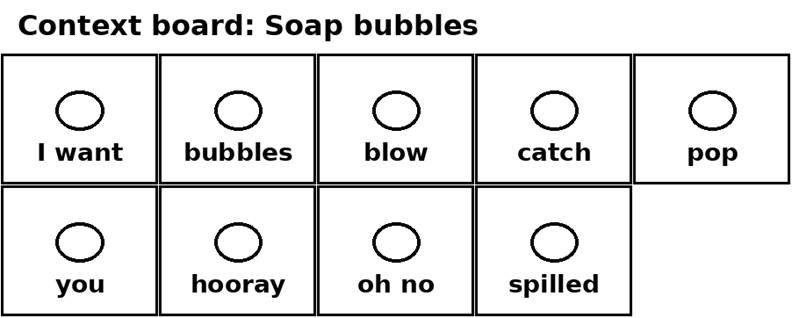
Figure 6.8. Context board “Soap bubbles”. Source: MÓWik symbols, p. 133.
2. Participatory reading is one of the methods used in augmentative and alternative communication (AAC) to support the development of communication in nonspeaking children or children who have difficulties communicating. Ewa Gajewska emphasizes that this method is based on interactive shared reading by the parent/teacher and the child, during which the child is not a passive listener but actively participates in the activity. The child may join in reading by pointing to graphic symbols or pictures, making gestures, vocalizing or using communication devices.
Participatory reading creates a natural context for developing communication skills such as requesting, refusing, commenting, asking questions and making choices. An important element of this method is active cooperation between the parent/teacher and the child. While reading, the parent/teacher pauses and encourages the child to complete the text using available forms of communication, which develops understanding of content and the ability to build utterances.
The importance of PCS (Picture Communication Symbols) is significant, as they are an important tool of alternative communication. By using graphic symbols, nonspeaking children can actively participate in reading, follow the story and express their needs and emotions despite limitations in verbal speech.
The effectiveness of participatory reading depends on appropriate adaptation of teaching materials to the child’s psychophysical abilities. Books used during sessions should include simple illustrations, short texts, repeated phrases and elements that engage the student’s attention and senses. It is possible to create one’s own educational books and to use communication devices such as Big Mack or Step by Step.
Participatory reading brings many educational and therapeutic benefits. This method develops joint attention, teaches turn-taking, strengthens the sense of agency and motivates the child to communicate and engage with books. It also supports language development, expands vocabulary and prepares the child for learning to read. The positive relationship between parent and child and an atmosphere of safety and acceptance are important, as they support communication development and activity.
Reading is an excellent way to develop imagination, vocabulary and cognitive functions. It helps work on joint attention and provides an opportunity to learn turn-taking and interaction with another person. From the earliest years, children become familiar with books by looking at pictures, pointing, making sounds and onomatopoeia, and by learning rhyme and rhythm. Children with disabilities often do not have the opportunity to interact with books in this way. Due to lack of speech and motor limitations, they become passive listeners of content chosen by adults, which results in short concentration and attention because they cannot interact. Thanks to the interactive (participatory) reading strategy, a person with intellectual disability can actively participate in this activity. It should be remembered, however, that the environment must be properly prepared for reading: seating, an adapted book and additional aids such as toys, props, communicators, symbols and communication boards. A properly selected book gives the user an opportunity to engage actively in the reading process at many levels of experience: emotional, sensory, cognitive and linguistic.
Material adapted for people with complex communication needs should include:
• short poems and songs accompanied by simple illustrations,
• refrain and preview lines that build curiosity and motivation,
• rhythm and rhyme,
• clear structure,
• manual elements (pages that are easy to turn, e.g. thick pages adapted to motor abilities, pieces of fabric, strings and other elements enabling independent page turning).
Many people with multiple disabilities love discovering additional elements in books, opening flaps and touching textures. Books containing sensory parts make it possible to activate the sense of touch. Reading can be done with users at every level of functioning - both with those who understand the text and with those for whom the content does not yet have meaning.
During participatory reading, a person may:
• open the book, turn pages and use movable elements,
• produce messages such as: what next?, next page, I want more,
• use toys and props,
• create a reading aid with the teacher, e.g. stick on elements, symbols or photographs,
• say a message containing part of a repeated line (the student may finish or start the interaction),
• list elements of the text using multi-level communicators,
• complete a sentence or line with a symbol,
• participate in dialogue, e.g. while reading dialogic rhymes,
• use single symbols or communication boards that make it possible to comment, ask questions and add information, e.g. with a symbol or word.
Reading skills increase independence, broaden the possibilities of spending free time, and form the basis for further education and multi-stage development (from turning pages to learning to write and read).
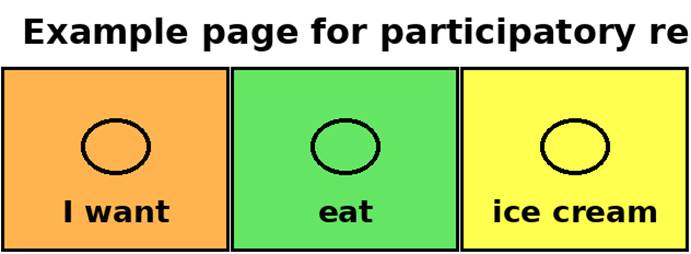
Example page of a book for participatory reading, source: own resources, Boardmaker symbols.
High-tech communication aids.
There are many AAC programs available on the Polish market that help adapt teaching aids to the needs of a nonspeaking student, and even a student with severe motor limitations. The use of these programs facilitates, and sometimes makes possible, active participation in interpersonal communication. The most useful and popular include:
Boardmaker Speaking Dynamically Pro - a program for editing, printing and creating dynamic boards with PCS symbols. It can be used to create communication boards and dynamic teaching aids. It can also be used by students with motor disabilities when appropriate equipment is used, such as switches with an interface.
Grid 3 - a program for creating dynamic boards. It can be used to create communication boards and dynamic teaching aids. It is suitable for students with motor disabilities when appropriate equipment is used, such as switches with an interface. It makes it possible to create boards through which a user with motor disability can operate other applications, such as YouTube or music programs.
SymWriter - a program for creating worksheets and communication boards.
PCEye 5 - a device and software for controlling a computer using eye gaze. It is compatible with Windows computers and laptops.
C-eye Pro system - a stationary device and software for controlling a computer using eye gaze. It enables communication via computer. It is not portable and is therefore particularly useful for people who do not leave their room, for example in hospital or at home.
MÓWik - an aided communication program for Android mobile devices. It includes symbols, dynamic boards and speech synthesis. It has a Polish grammar system and is also available with grammar in other Slavic languages.
GADAczek and MÓWik Book - applications for Android devices, also available in free versions. They imitate the use of button-based communication aids. Messages can be recorded and symbols and photographs can be inserted. They are useful for creating communication boards in different situations, especially when non-synthesized speech with intonation and expression is needed, for example for singing songs, acting in a puppet theatre or participatory reading.
LetMeTalk - a mobile application for iOS devices with a speech synthesizer. It is based on the availability of symbols from the Arasaac database. It enables the creation of communication boards and sentence building.
Click AAC - an experimental augmentative and alternative communication application developed by researchers from the School of Information Studies at McGill University in Canada. This free application aims to help people with disabilities communicate by using pictographic symbols. Click AAC automatically generates vocabulary symbols related to the scene shown in an input photograph. Users can produce computer-generated speech by clicking on the symbols. Click AAC offers three types of vocabulary options: descriptive, related and narrative. It is fully customizable, allowing users to remove unwanted vocabulary items, edit them, add new words and phrases, and change the order of photographs and vocabulary items. The application is very flexible because users can adjust the size of each component in the interface to their needs.
Cboard - a free web application for children and adults with speech and language disorders that can support the communication process. It allows users to create their own boards. Cboard is available on different platforms, including desktop computers, tablets and mobile phones. It also supports a wide range of languages, so it can be used in different life situations.
CoughDrop - a tool designed for people who, for various reasons, cannot communicate. Thanks to cloud functionality, it offers offline work with automatic data synchronization. This means that all created boards are available on every device on which the user is logged in. CoughDrop gives access to a wide range of symbols such as Arasaac, PCS, SymbolStix and users’ own graphics, which allows communication to be better adapted to the user’s needs. The program also allows supervisors to be connected, so they can monitor the user’s progress and modify communication boards. This greatly facilitates building a communication environment and supports the therapeutic process. In addition, the program can be used on different devices through touch, mouse, scanning and eye tracking, making it possible to adapt the interaction method to the user’s abilities and preferences.
neuroTab - a tablet with software for comprehensive rehabilitation of cognitive functions, adapted for people with various neurological deficits. It has a ready-made communication book with a speech synthesizer for children and adults.
Ewa Przebinda, Mirosław Michalik and Ewa Grzelak identify a series of guidelines that help aided language stimulation bring results.
Do not quiz or test.
Aided language stimulation is based on processes similar to the way typically developing children learn their native language: they hear speech in natural contexts and in different situations. People with complex communication needs who are learning to use AAC should also be allowed to immerse themselves in the sign language they are learning. Before we begin to ask questions, offer choices and require answers, there must be a period of modelling without demands, during which the communication partner speaks and uses signs in real situations but does not expect or require any reaction or answer from the student. It is also important to ensure that the situations in which we model are engaging and attractive for the learner. Time spent modelling without demands is not wasted time; it should be seen as an investment in the further therapeutic process, in which trust, relationship and motivation to communicate are built.
Do not require imitation and repetition immediately.
In the literature on augmentative and alternative communication, aided language stimulation is also called AAC modelling or modelling that supports language development. It should be emphasized that this term does not mean teaching in which imitation is expected immediately after the model has been demonstrated. The purpose of aided language stimulation is to teach spontaneous communication by presenting the meaning of signs and the way they are used in a natural context, and by creating situations in which the student is engaged in using this knowledge. This should not be confused with requiring the learner to imitate immediately after presentation. After a period of modelling without demands, spontaneous use of signs is observed in people with complex communication needs.
Take age, personality and interests into account.
There is no minimum or maximum age at which augmentative and alternative communication can be introduced. However, it is important to adapt the content to the person’s age and way of learning. It is also necessary to ensure an appropriate level of interest, engagement and motivation. It is the communication partner’s role to create situations that are attractive for the learner and to support the development of communication intent. Instead of teaching vocabulary by presenting pictures, such as “The boy is EATING ICE CREAM,” it is better to use AAC signs while the student is eating real ice cream.
Make sure the student can observe, but do not require looking.
Use aided language stimulation near the learner, but do not require looking and do not use commands such as “look” or “look here.” Many people with complex communication needs use peripheral vision or cannot process visual and auditory information at the same time. Through many opportunities to observe the use of a sign in context, they can learn to acquire information in the way that is optimal for them.
Highlight key words according to the principle of graded difficulty.
When addressing the student, focus on highlighting key words in the sentence, which means it is not necessary to produce/point to every sign in the sentence. The recommended strategy is graded difficulty, i.e. pointing to/producing one sign more in an utterance than the student can point to/produce independently. If the learner does not yet use signs, we represent only one concept in the sentence with a symbol; if they use one, during modelling we indicate two symbols, and so on.
During aided language stimulation, speak in complete sentences.
During modelling, complete sentences should be spoken to provide a correct language model, but only individual signs should be produced/pointed to in the student’s AAC system. The sign must be produced/pointed to at the same time as it is spoken in the sentence, e.g. “Now we are going to eat SOUP.” In the case of a high-tech device with speech synthesis, the word may sound in an uninflected form, but the communication partner should say it in the correct form, thereby supplementing it and providing the correct language model, e.g. “Oh no, there is no SHOE” - we click the symbol labelled “shoe” but say the correct form in speech.
Do not require grammatical correctness from the very beginning.
In the process of language acquisition in a typically developing child, an increase in the number of mastered words and communication functions is observed first, followed by development in the length of utterances. Grammar and knowledge of its rules is an area that develops later. On this basis, it is recommended that during aided language stimulation the emphasis should first be placed on increasing vocabulary and communication functions and on creating longer and longer utterances, and only later on the grammatical aspect, for example through the strategy of expanding utterance length. In addition, a communication partner who always says grammatically correct sentences provides a correct auditory and language model. For example, the learner points to the symbols “car,” “go” and “shop,” and the partner responds: “Yes, you are right, we will GO BY CAR to the SHOP.”
Use the strategy of expanding utterance length.
This strategy consists in enriching the AAC user’s utterance by one element in relation to what the user has already demonstrated. In this way we increase vocabulary, teach sentence building and expand the repertoire of communication functions. We repeat what the AAC user has conveyed, adding one element to the utterance, e.g. student: “eat” - communication partner: “I WANT TO EAT”; student: “jump” - communication partner: “JUMP MORE.” In this way we show how to build sentences and combine symbols in new configurations, paving the way to the main goal of AAC intervention - the appearance of spontaneous utterances that have never been taught before.
The three-to-one rule.
This rule aims to reduce the number of questions directed at the child and support speech development. Asking too many questions may lower motivation to communicate and turn dialogue into an interrogation. Before the communication partner asks any question, they should make sure that every question is preceded by three statements that do not require the student to answer, e.g. “Oh, look, a CAR is GOING. Oh, and this CAR is so BIG. I wonder WHERE it is GOING. Where do you GO BY CAR?”
The need for perseverance.
Learning a new communication system takes time, and some students will need more opportunities to learn signs and more examples of their use. One must be patient and continue using aided language stimulation. The communication partner also has to learn the communication tool and the location of symbols. If the learner already uses signs spontaneously, modelling should not be discontinued; their utterances should continue to be expanded with new functions and words.
Whenever possible, model in the individual communication tool.
Aided language stimulation should take place in the individual communication tool, except in situations where access is impossible or difficult. A constant and unchanging location of signs supports the process of learning the meaning of symbols. This phenomenon is known as motor memory and supports us in everyday situations by relieving memory load, for example when entering PIN codes, typing on a keyboard or using a phone. Changing the location of a symbol in the communication tool slows down the process of creating utterances and burdens memory: the user has to focus not only on what they want to communicate, but also on finding the right symbol.
The more people use aided language stimulation, the faster the learning process proceeds.
Ideally, every person around the individual who needs AAC should become involved in aided language stimulation, because this creates more opportunities for the child to learn the meaning of symbols. All people involved in modelling - parents, siblings and therapists - are valuable. It is worth emphasizing that in real life it may not be possible to achieve full involvement of the environment, but this does not mean that AAC is not worth introducing. In learning communication, there is no “all or nothing” rule. In practice, modelling often begins in one environment and the number of people modelling gradually increases.
Aided stimulation throughout the day.
Learning to use AAC signs requires many exposures to modelling during the day. A minimum of 200 such situations per day is recommended.
Aided language stimulation in naturally occurring situations.
Daily routines can be used to teach the meaning of signs through aided language stimulation. Every day we perform a series of activities that happen naturally and do not need to be arranged. These include meals, going for a walk or to the shop, cooking and washing. For modelling, we first choose routines that are pleasant and neutral for the student.
Funded by the European Union. Views and opinions expressed are however those of the author(s) only and do not necessarily reflect those of the European Union or the National Agency for Community Programs in the Field of Education and Vocational Training (ANPCDEFP). Neither the European Union nor ANPCDEFP can be held responsible for them