
MODULE III FOR TEACHERS Foundations of Augmentative and Alternative Communication (AAC)
MODULE III FOR TEACHERS Foundations of Augmentative and Alternative Communication (AAC)
Section outline
-
MODULE III
FOR TEACHERSFoundations of Augmentative and Alternative Communication (AAC)
Augmentative and Alternative Communication technique for Inclusion (AAC-Inclusion)

Practical AAC Strategies
1. Daily schedules
Daily schedules are a graphic presentation of the stages of the day, for example lessons, classes or activities. The benefits of using daily schedules include developing the concept of time, enabling communication about the past and the future, increasing the student's sense of security, ensuring consistency and thereby reducing challenging behaviours, preventing rigid routines and frustration, learning to delay gratification, and supporting comprehension and receptive language. Daily schedules are particularly useful for students who:
· ask the same questions repeatedly about activities and people that are important to them, such as a specific toy or a parent's return;
· have significant difficulty understanding the concepts of “now” and “then”;
· show difficulties with concentration;
· have difficulty with changes;
· have problems moving from one activity to another.
Each element of the schedule should represent a separate part of the lesson or day. These may be clearly distinguished activities or tasks, such as singing, writing or listening. They should be named in a way that is clear to the student. For example, instead of using the phrase “auditory memory exercises”, use the symbol “listen”.
The schedule should be arranged with the student or students at the beginning of the lesson or day. A strategy that may positively influence student motivation is to prepare one or two more activities than there are places in the schedule, and then allow the student to reject selected items from the timetable. The schedule should be an integral part of every day. It is prepared daily during introductory activities, which usually last 30-60 minutes.
Elements of the daily schedule:
Attendance board - prepare photographs, or photographs with names, of all students. After arriving at school, students place their photograph on the attendance board, check who is present and who is absent, and greet one another. In younger classes, the greeting may be combined with a song, a toy, passing a bell or toy from person to person, blowing out a candle, and similar activities. This part of the lesson is useful for introducing questions such as “who?” (“Who is here?”, “Who is absent?”, “Who is ill?”, “Who is still on the way?”), “why?” (“Why is he/she absent?”, “Why is he/she late?”), “when?” (“When will he/she be here?”, “When will he/she return?”), “where?” (“Where is he/she?”, “Where was he/she?”), and others. At first, students learn to answer questions appropriately; later they begin to ask them independently.
Daily schedule:
Preparation - remember that the symbols indicating particular lessons or activities are the first time-related concepts that students will use. Name them so that students understand what will happen. Therefore, instead of “integrated education” or “functioning in the environment”, use “cooking”, “art activities”, “counting”, “writing and reading”. For some students, even these concepts may be too difficult; they will need specific information about events. For example, instead of “art activities”, at the beginning introduce the symbols “painting”, “drawing”, “cutting”, or other symbols that indicate the exact activity to be performed.
You can arrange the schedule together with the students or simply discuss it with them. Some students, especially at the beginning of using a daily schedule, will not be able to observe the whole schedule being created. In that case, prepare the schedule in advance and then show what will happen step by step throughout the day.
You can attach the elements of the schedule with Velcro to a piece of carpet, magnetic tape to a metal board, adhesive putty, or place them on a special shelf. It is important that the schedule is visible from a distance. If students have visual-motor coordination problems, apraxia, or similar difficulties that make pincer grasp difficult, you can make it easier for them to remove and attach symbols by fixing a piece of cork, polystyrene or thick foam to the back of each symbol so that it can be grasped with the whole hand.
In order for students to learn how to use the schedule, they should remember what the individual symbols mean. For this purpose the schedule should be used throughout the whole day. After an activity has finished, for example the bathroom, the student removes the symbol and puts it into an envelope, box or similar container. Then you look together at what will happen next and ask: “What now?”. You can take the next symbol with you and place it in front of the student; for example, the “dinner” symbol lies on the table during the meal. This procedure should be used until students understand that the symbols represent activities that follow one another.
At later stages, it is enough to turn over the symbols after completed activities and then point to them.
Ways of teaching students to recognise symbols representing activities during the day:
· Learning primarily takes place while the schedule is being used during the day, as described above.
· The student selects the appropriate symbol from two, three or four symbols, and later from a larger number, helping to match symbols to individual activities. When working with students who indicate choices with their eyes, use an E-tran frame.
· Ask the student what he or she likes in the daily schedule, what he or she likes and does not like.
· Introduce “sabotage” - pretend that you have mixed up the symbols so that the student can correct you.
· Add a board with daily schedule symbols to the student's personal communication aid. This will allow the student to tell family members what happened at school.
· Introduce symbols for time concepts, for example the symbol “now”.
· Mark what you are currently doing with the “now” symbol. Say, for example: “We have finished lunch. What now?”. Then move the symbol, by yourself or with the student, as you move on to the next activities. The student understands the concept and knows the symbol if he or she knows that “now” is the next symbol after a completed activity, not the previous one or the one representing a favourite activity.
· The next concept is “then” or “before”, depending on what is easier and more important for the student to understand. For students with intellectual disability and cerebral palsy, “before” is often easier, because it refers to something they have already experienced. For students on the autism spectrum, “then” is usually more important and should often be introduced next.
· “Yesterday”, “today” and “tomorrow”. The names of the days of the week are usually not meaningful for students, even if they can recite them in order. Introducing these concepts helps them orient themselves in the nearest time frame - three days - and then supports the introduction of a broader time perspective. Begin with “today”, then introduce “tomorrow” and “yesterday”. When introducing these concepts, refer to events that are meaningful to students and associated with positive emotions, such as music with a favourite teacher.
· Days of the week. Introduce these only when students can use “yesterday”, “today” and “tomorrow”. Assign a characteristic recurring event to each day, for example Monday is the day of dog-assisted therapy and Tuesday is the day of the theatre activity. First prepare a weekly schedule. On its basis, students can infer the daily schedule.
· Seasons. Initially, seasons are not time concepts for a child; they are associated with weather, clothing, holidays and celebrations. For example, spring is when it is warm and you can go outside without a hat. Seasons may be treated as time concepts only when children understand “week” and “month”.
· Months should be introduced only when children understand the days of the week and their cyclical nature, for example that Monday always follows Sunday, even if we do not go to school. It is worth introducing the concept of a month together with counting its days because students may confuse the overlapping systems of numbering.
The “now, then” schedule
A simple “now, then” board can also be used to show the consequence of completing a task. An activity that is challenging for the student should be paired with an attractive consequence, for example now reading, then listening to music. This schedule contains only two symbols: one for the current activity and the other for the activity that follows. It can be used as the beginning of learning to use schedules, and it is also helpful for students who have particular difficulty changing activities or focusing on them.

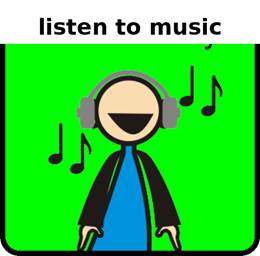
Source: symbols: MÓWik.
2. Visual representation of the passage of time
Learning to understand time is a challenge for many students. Even students who can tell the time may have difficulty distinguishing shorter periods of time or using this knowledge under stress. It may help to add time markings to the daily schedule in digital form or as a picture showing the appearance of the clock at a given time. Visual timers, such as the Time Timer, are useful for supporting the understanding of time passing. At the very beginning, short intervals are recommended, even one or two minutes; for example, the student colours for two minutes. The timer is set next to the student so that it is visible throughout the activity. When the time is over, the activity changes immediately. The duration of activities should then be gradually extended. It is useful to combine visual strategies, for example placing “now, then” cards and a visual timer on the student's desk.
Visual marking of space in the classroom or therapy room
To help the student distinguish areas in the room according to their functions, it may be useful to label these places with symbols, for example play, learning and relaxation zones. Similar labelling may also be used for objects, for example the contents of cupboards and drawers, where symbols such as blocks, puzzles or toys are placed.
Visualisation of instructions
One of the greater challenges in therapeutic work is giving instructions effectively. Verbal instructions require good language comprehension, memory and auditory processing. To help the student carry out an instruction and understand what is expected, the messages addressed to the student can be illustrated with symbols. This may be particularly useful during feeding therapy or breathing exercises.
Benefits of visual support for instructions for the student:
· increased attention and focus,
· increased concentration,
· increased independence.
Benefits of using visual support for instructions from the perspective of the speech therapist:
· less time spent repeating the same instructions and prompts,
· easier planning and structuring of instructions.
Before creating a visual aid to support giving instructions, it is necessary to analyse which words and instructions are most frequently used for the given activity. Next, print the symbols representing them in a format that is visible to the student. The symbols should be easily accessible to the therapist; for example, a binder with symbols placed on the desk or a lanyard with symbols can be used.
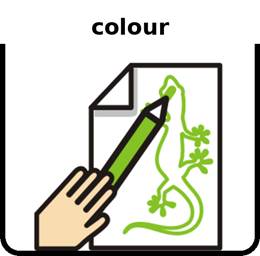
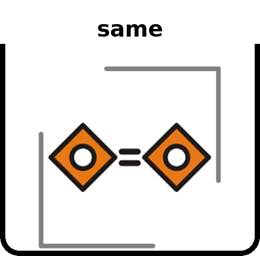
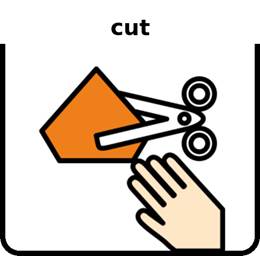
Visualisation of instructions, own resources, source: MÓWik symbols.
Volume scale
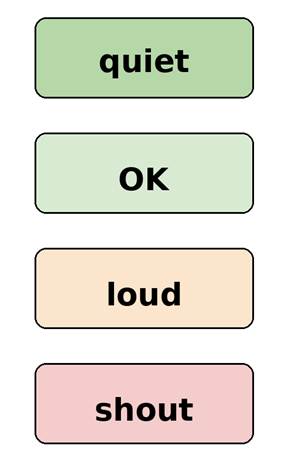
Many students have difficulty grading the loudness of their voice and recognising how loudly they speak or, in the case of non-speaking students, vocalise. A helpful tool in this situation may be a voice scale with vertically arranged symbols, for example “quiet”, “OK”, “loud”, “shout”. The speech therapist points out where the student's voice is on this agreed scale in order to make the meaning of these concepts clear.
Using reinforcements and motivators
Many students may have difficulty completing tasks and following instructions. Praise from the therapist alone may not be sufficiently motivating for them to engage in and complete a task or instruction. For this group of students, it is advisable to use reinforcements and a visual representation of the conditions for receiving them. When selecting motivating objects and activities, observation, discussion with parents or guardians, and consultation with teachers are recommended.
After reinforcements have been selected, it is necessary to decide what conditions the student must meet in order to gain access to the reinforcement, and for how long, in what amount, or how often it will be provided. The student must have clearly presented expectations with a clearly defined outcome; for example, the student must complete three worksheets in order to play with blocks for five minutes.
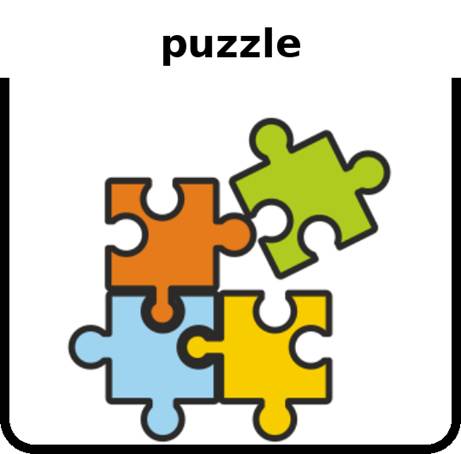
Next, show both the way of marking the stages that separate the student from the reinforcement and the reward itself. The simplest form is colouring in or covering the stages leading to the reinforcement. Another option is to cut the reinforcement symbol into puzzle pieces, with as many pieces as there are stages required to obtain the reward. After each task, the student receives one piece of the picture and gradually completes the reward. Once the picture is complete, the student receives the reward. Boards with attachable tokens or buttons, as well as stickers, may also be used.
Map of alternative consequences
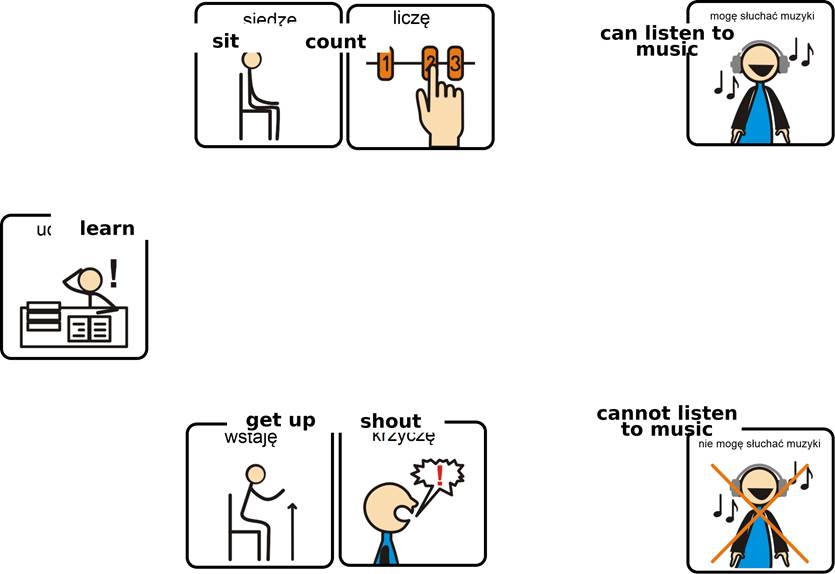
This is a visual representation of the relationship between expectation, behaviour and consequence. The purpose of this type of map is to show graphically both the expected behaviour and the reward for it, with both options presented at the same time. The map must show:
· a common antecedent that occurs before both the undesirable behaviour and the appropriate alternative behaviour;
· a description of the undesirable behaviour and the appropriate alternative behaviour;
· the consequences of both behaviours.
Using visual support in therapeutic work with speaking students may initially raise objections, as AAC is often associated mainly with strategies for non-speaking students. However, it is important to realise that each of us uses various forms of visual support in everyday life: calendars, timetables, bus schedules, road signs, and so on. Thanks to them, we remember and understand expectations more easily. Our students and patients should be able to experience the same benefits.
Own resources; source: MÓWik symbols.
Using a choice board during educational activities
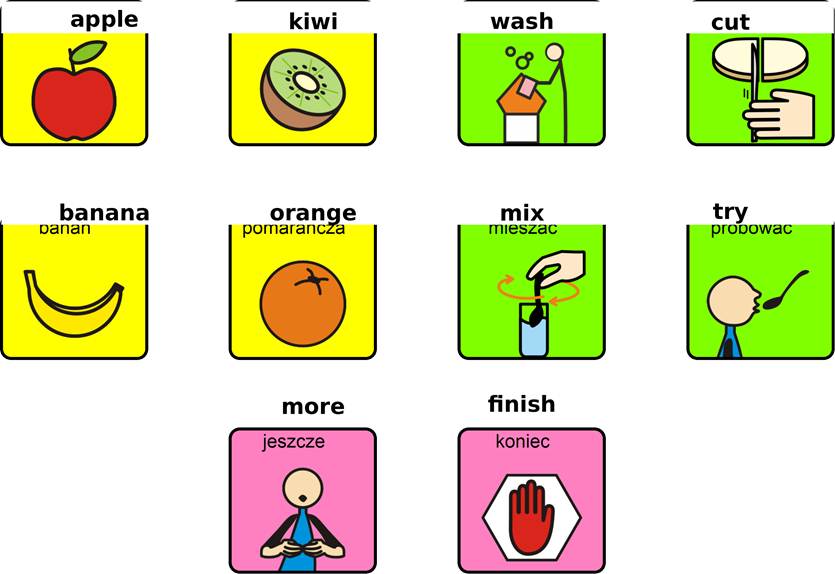
A choice board contains symbols representing concepts from which the student can choose an object, activity, game, food item and so on. Symbols are helpful at the stage of working with students who are just beginning to learn communication. They enable the functions of requesting and asking for something. The student makes a free choice without the possibility of making a mistake - the indication is always valid and is not judged negatively or positively by the communication partner. Sometimes the student's wish cannot be fulfilled for objective reasons. In that case, say, for example: “You are showing that you want YOGHURT. I understand. But today there is none, because Mum probably forgot to put it in your backpack. You can choose something else - JUICE or JELLY”, while the teacher points to the appropriate symbols. The choice must be closely related to the situational context and to the current situation. It is not acceptable to encourage the student to choose, for example, what he or she will want to do in a few hours and then enforce that choice later. During choice-making, misunderstandings may occur, so it is always necessary to say aloud how the indication has been understood, for example: “You are showing blueberries. Do you want us to sing a song about blueberries?”. The student then has a chance to change the message if the symbol was chosen by mistake.
Own resources; source: MÓWik symbols.
Working with a participation board during games and play in class
Participation boards contain vocabulary that enables linguistic and practical participation in a specific social situation. They are useful in situations involving many different interactions - in the teaching process these are most often group games and play. The vocabulary focuses on messages that facilitate and enliven interaction between users. Symbols represent comments (“great”, “good”, “bad”), polite phrases (“congratulations”, “thank you”, “please”), expressive exclamations (“oh no!”, “oh dear!”, “come on!”, “super!”, “bravo!”), questions (“who now?”, “whose turn?”, “what now?”), game rules, instructions (“throw”, “now me”, “do not cheat”), directing phrases (“let's play!”, “we throw”, “we count”) and corrective phrases (“what am I doing?”, “how are you throwing?”, “not like that”), agreements (“first me, then you”, “let's swap”), and counting down (“three, two, one, start”) (Boniecka, 1996). The vocabulary may change depending on the type of game, but some phrases are universal in every game situation, regardless of the activity. This is core vocabulary, whereas vocabulary that changes is fringe vocabulary. For example, the phrase “hooray!” is useful in every game, whereas the word “pawn” appears only on boards used for games involving pawns.
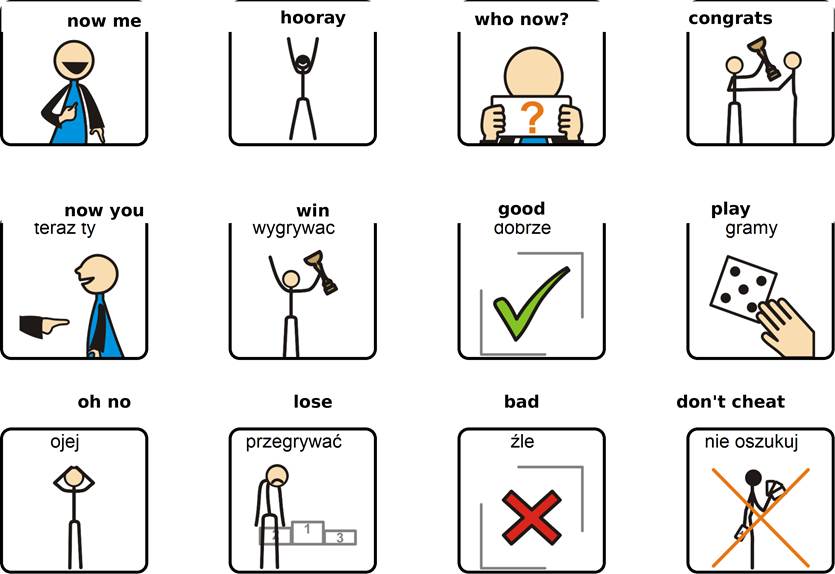
Figure 6.7. Participation board “Game”, source: MÓWik symbols, p. 132.
Creating a contextual board using photographs
A contextual board contains vocabulary used in a strictly defined situational context. It is not intended for talking about a topic detached from that context. It should include different parts of speech; symbols representing concepts connected with the situation and used to name or request objects, activities, features and people belonging to that situation; and conversational phrases, such as exclamations, polite phrases, requests and questions, typically used in that context. Contextual boards can be created in two ways. For students beginning to use AAC, boards are created on the basis of a photograph of a given situation. For example, on a large photograph showing play with favourite soap bubbles, symbols are placed to represent individual concepts. The board may be paper-based or electronic, used with an interactive whiteboard or a touch-screen device such as PowerPoint, Grid, Mówik Book or Boardmaker SDP. Electronic boards are more attractive because when the student touches a particular place in the photograph, the corresponding message is heard.
A board for more advanced students no longer has a photograph as its background, but it still contains vocabulary only for the given context. Sometimes contextual boards with symbols only are a continuation of boards based on a photograph and contain symbols that the student has already learned while using the photo-based contextual board; the photographic prompt is then removed.
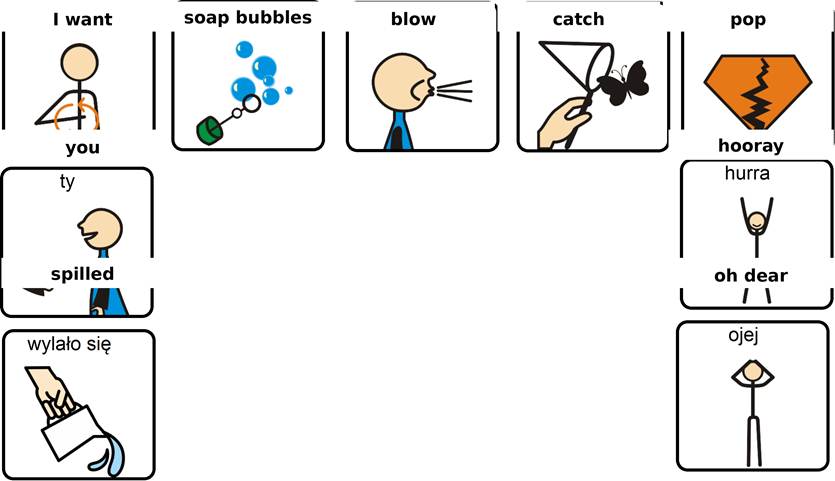
Figure 6.8. Contextual board “Soap bubbles”, source: MÓWik symbols, p. 133.
Using a thematic board during a lesson
Thematic boards allow students to acquire school knowledge more effectively by answering factual questions and more easily consolidating curriculum content. They expand vocabulary in a given thematic area. The user communicates what he or she knows, not necessarily what has recently been experienced. The signs are arranged in vocabulary groups and support the use of colour coding and the Fitzgerald key. They contain vocabulary relating to one topic.
Lesson situations are an excellent opportunity for students to acquire both receptive and expressive vocabulary. Non-speaking students often have a significant delay in this respect compared with speaking peers, regardless of their level of cognitive skills. A developmental approach to language acquisition distinguishes several stages in the use of particular vocabulary. Non-speaking students who were introduced to aided communication late often have serious gaps in this area, while certain vocabulary is necessary in order to acquire the knowledge included in the curriculum.
2. Participatory reading
Participatory reading is one of the methods used in augmentative and alternative communication (AAC) to support the development of communication in children who are non-speaking or have difficulties communicating. Ewa Gajewska emphasises that the method is based on interactive shared reading by the teacher and the child, during which the student is not a passive listener but actively participates in the activity. The child may take part by pointing to graphic symbols or pictures, making gestures, vocalising or using communication devices.
The author notes that participatory reading creates a natural context for developing communication competences such as requesting, refusing, commenting, asking questions and making choices. An important element of the method is active cooperation between the teacher and the child. During reading, the teacher pauses and encourages the student to complete the text using available forms of communication, which develops comprehension and the ability to build utterances.
The author also emphasises the importance of PCS (Picture Communication Symbols), which are an important AAC tool. By using graphic symbols, non-speaking children can actively participate in reading, follow the course of the story, and express their needs and emotions despite limitations in verbal speech.
According to Gajewska, the effectiveness of participatory reading depends on the appropriate adaptation of teaching materials to the child's psychophysical abilities. Books used during lessons should include simple illustrations, short texts, repeated phrases and elements that engage the student's attention and senses. The author also points to the possibility of creating one's own educational books and using communication devices such as Big Mack or Step by Step.
Ewa Gajewska notes that participatory reading brings many educational and therapeutic benefits. It develops joint attention, teaches turn-taking, strengthens the sense of agency, and motivates the child to communicate and engage with books. It also supports language development, expands vocabulary and prepares students for learning to read. The author stresses the importance of a positive relationship between teacher and child and of creating an atmosphere of safety and acceptance that supports the student's communication and activity.
Reading is an excellent way to develop imagination, vocabulary and cognitive functions. It helps develop joint attention and provides an opportunity to learn turn-taking and interaction with another person. From the earliest years, children become familiar with books by looking at pictures, pointing, using sounds and onomatopoeia, and learning rhythm and rhyme. Children with disabilities often do not have the opportunity to experience books in this way. Due to lack of speech and motor limitations, they become passive listeners to content selected by adults, which results in short concentration and attention because they cannot interact. Through interactive or participatory reading, a person with intellectual disability can actively participate in this activity. However, it is important to prepare the environment properly: seating, an adapted book, and additional aids such as toys, props, communicators, symbols and communication boards. A well-selected book enables the user to participate actively in the reading process on many levels of experience: emotional, sensory, cognitive and linguistic.
According to Smyczek, materials adapted for people with complex communication needs should include:
· short poems and songs presented against simple illustrations,
· refrain and preview lines that build curiosity and motivation,
· rhythm and rhyme,
· a clear structure,
· manual elements, such as pages that are easy to turn, thick pages adapted to motor abilities, pieces of fabric, strings and other elements that allow the user to change pages independently.
Many people with multiple disabilities enjoy discovering additional elements of books, opening flaps and touching different textures. Books containing sensory elements make it possible to activate the sense of touch. Reading can be carried out with users at every level of functioning - both with those who understand the text and with those for whom the content does not yet have meaning.
A. Smyczek states that during participatory reading a person may:
· open the book, turn the pages and use movable elements;
· produce messages such as “what next?”, “next page”, “I want more”;
· use toys and props;
· create a reading aid with the teacher, for example by attaching elements, symbols or photographs;
· produce a message with part of a repeated line, ending or beginning an interaction;
· count elements of the text using multi-level communicators;
· complete a sentence or line with a symbol;
· participate in dialogue, for example while reading dialogic rhymes;
· use single symbols or communication boards that enable commenting, asking questions and adding information, for example with a symbol or a word.
The ability to read increases independence, expands opportunities for spending free time and forms the basis for further education and multi-stage development, from turning pages to learning to write and read.
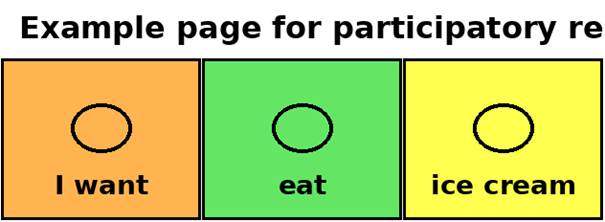
Example page of a booklet for participatory reading, source: own resources, Boardmaker symbols.
3. Criteria for the effectiveness of AAC interventions in the school and home environment
Implementing interventions that support a student's communication is a task for the whole team of specialists working with the student at school. Understood in this way, the process of building communication competences supports the development of the AAC user. Involving all members of the team in the child's aided communication system is a condition for effective teaching.
M. Grycman, M. Jerzyk and M. Bucyk state that the student's interests are the basis for developing communication competences. Planning aided communication interventions is preceded by identifying activities that the student likes and that are important to the student; these become the first areas of intervention. When identifying the student's interests and gathering information about preferred ways of spending time, the teacher involves the parents and other school staff. The information obtained is recorded in the form of a list, table or questionnaire. On the basis of the areas defined in this way, the teacher selects coherent procedures, that is AAC strategies.
Example of recording a student's interests
ALEKSANDRA
Attractive toys and objects
Handbags, shoes, jewellery, clothes with sequins, crystals and prints.
Preferred meals and drinks
Tomato soup, dumplings, sweets, salty sticks/crackers, corn puffs.
Ways of spending time with other people
Walks, looking at photographs, listening to stories from before the accident, painting nails.
Ways of spending time alone
Watching TV series such as Rodzinka.pl and M jak miłość, watching the news programme Panorama, watching cabaret performances and funny videos featuring young children and animals.
Source: M. Grycman, M. Jerzyk and M. Bucyk, “The Active Model. Augmentative and Alternative Communication”.
The authors emphasise that planning the course of the day and individual educational activities is a condition for satisfying the AAC user's need for security. Visual techniques make it easier to notice events that follow one another. A consistent way of proceeding during specific activities, such as brushing teeth, using the toilet or making a sandwich independently, helps the user understand and plan complex skills. Aids developed in this way allow the user's activities to be organised, their course to be predicted, and the user to act in a task situation.
Group activities are the basic form of work in many institutions. Engaging in group communication, for example during meetings with other children, provides an opportunity to use acquired skills. Supporting strategies are the basis for planning and carrying out group activities. Start by identifying activities that are attractive to the students and then introduce them into group work. To achieve the set goals, the teacher determines the students' target behaviours and describes exactly how the strategy will be implemented, indicating the activity that supports the teacher.
Group strategies allow students to learn socially accepted ways of initiating and maintaining interaction with another person. A participant learns to wait for his or her turn and to observe the actions of other group members. The overarching goal of activities is always to build joint attention and circular relations between participants.
Participation in group activities also improves the ability to use individual AAC aids because such activities give the teacher an opportunity to model more complex utterances and provide opportunities to search for and expand vocabulary, as well as to find new and interesting topics for conversation.
M. Grycman, M. Jerzyk and M. Bucyk emphasise that interventions in aided communication are effective only when they are embedded in the natural environment of the non-speaking person. Family involvement in the process of building ways of communicating is crucial.
Introducing aided communication interventions is a complex process. It involves systematic and staged inclusion of families in the development of their children's communication competences.
First, the AAC specialist shows the parent how to recognise the child's spontaneous communicative behaviours and how to respond to them appropriately. Next, the specialist introduces the parent step by step to artificial, planned situations that teach ways of communicating. Acquiring new competences is based on repeated practice of these situations. During this process, the AAC specialist and the parent share and agree on the interpretation of the child's communicative behaviours and then create a communication profile that includes all of the child's behaviours and their probable functions. These actions are spread over time, and the communication profile is updated as communication competences develop.
Magdalena Grycman, Monika Jerzyk and Magdalena Bucyk present the following criteria for effective AAC interventions in the family environment:
The parent's emotional readiness. Openness to attempts at non-verbal communication.
Opening up to attempts at non-verbal communication and getting to know families that have successfully introduced aided ways of communication can change beliefs about the possibility of effective communication with the child.
Readiness to recognise the child's independence.
Recognising the child's right to express will and make decisions in basic areas, such as what he or she wants to play with or whether he or she wants to be swung, helps the parent see the child as a separate individual. Creating situations that support this and gradually increasing their number makes it possible to perceive the child as a conscious and independent person.
Consent to record AAC lessons or consultations during which aided communication interventions are used.
Systematic recording of activities during which communication support is introduced is the most important way to monitor changes in the acquisition of new communication competences. Recordings are especially helpful for families at the beginning of the process who have many doubts when thinking about the child's future communication abilities. Showing recordings to other family members helps them perceive the child's communication potential differently.
Recognition that aided communication requires rules and consistency.
Preparing parents for the role of communication partners begins with the first communication strategy proposed by the AAC specialist and requires continuity. Understanding this is crucial for the child's communication success, because building effective and mutually understandable aided dialogue requires consistency.
Introducing communication strategies into the family's everyday life.
In the process of creating supportive strategies, it is crucial to prepare parents, siblings and grandparents for the role of communication partners. The family member who works with the AAC specialist initially becomes a guide for the others and a teacher of these strategies. Understanding the child's needs and wishes positively influences the relationship. Time and many positive experiences in using AAC aids are necessary.
Readiness to invest one's own resources in the process of building the child's communication system.
Implementing aided communication strategies requires commitment and effort from the parent. The process requires a continuous search for internal motivation to introduce new supportive interventions into everyday life step by step.
Recording by the parent of aided communication interventions carried out at home.
In the process of acquiring communication competences, it is necessary to film how communication strategies are introduced at home. Recordings make it possible to modify the communication partner's behaviours and teach new models of action.
Regular meetings. Systematic and continuous interventions.
Learning to communicate is a process that develops unevenly and in leaps. Time frames and a detailed plan should be established in order to achieve successive communication goals.

Funded by the European Union. Views and opinions expressed are however those of the author(s) only and do not necessarily reflect those of the European Union or the National Agency for Community Programs in the Field of Education and Vocational Training (ANPCDEFP). Neither the European Union nor ANPCDEFP can be held responsible for them